



Summary
Ten questions worth asking before you sign with any trademark law firm, and how to tell a good answer from a red flag.
What to Ask Any Trademark Provider Before You Sign
For founders, general counsel, and brand teams managing more than a handful of marks. Not a guide for filing your first one.
Most provider conversations start with price. Price is not the first fork in the road. Structure is.
Every trademark provider sits somewhere on two axes: centralized or decentralized, and flat rate or billable hour. Where they sit determines what the relationship feels like in year two, not year one.
Billable hour | Flat rate | |
|---|---|---|
Decentralized | Multiple local firms, multiple invoices. No one owns the portfolio view. Cost swings by quarter. | Filing-mill platforms. Cheap per country, but the client coordinates every jurisdiction. |
Centralized | One relationship partner, one point of contact. Meter's still running. Total system cost unknown until the invoice lands. | One system, one price. Admitted counsel behind every jurisdiction. |
Centralized and decentralized are not about whether a provider uses local counsel. Trademark law is jurisdictional. Filing in Japan requires a Japanese attorney. Filing in Brazil requires a Brazilian one. Every serious provider, us included, works with admitted local counsel wherever the law requires it.
The real question is who absorbs the coordination. In a decentralized model, you do. You track which firm owns which mark, chase status updates, and reconcile invoices from five countries into one budget line. In a centralized model, the system does. Local counsel does the legal work. The system holds the estate together.
There's a reason this split exists. Billing by the hour pays for time spent, not for friction removed. A system that answers your question before you ask it also shortens the invoice. Decentralized, hourly providers have no financial reason to build that system. Centralized, flat-rate providers do, because the system is the product, not a byproduct of billing.
The ten questions, in short:
Centralized or decentralized?
Who's accountable for the portfolio, not just the matter?
What's excluded from "flat"?
What happens to the price at renewal?
What does a person do, and what does software do?
Is local counsel a fixed part of the system, or assembled per matter?
Can you see your live trademark count right now, without asking anyone?
Are your domains and your marks tracked together?
If you leave, do you keep your history?
Does the provider own its own software, or license someone else's?
Here's each one in depth.
Structure
1. Centralized or decentralized? Ask them to draw their own version of the grid above. If they can't place themselves on it in one sentence, that's the answer.
Good answer sounds like: a direct claim to one quadrant, backed by how invoices and status updates actually move today.
Red flag: "a bit of both," with no explanation of who does what.
2. Who's accountable for the portfolio, not just the matter? A law firm is accountable for the case in front of it. Ask who is accountable for the whole estate, every mark, every renewal, every jurisdiction, at once.
Good answer sounds like: a named system or role with visibility across the full portfolio, not one person's inbox.
Red flag: "your relationship partner." That's a person, not a system. People change jobs, and the portfolio doesn't automatically transfer with them.
Economics
3. What's excluded from "flat"? Almost every flat fee excludes something. Ask for the list before you sign, not after the first invoice.
Common, legitimate exclusions: oppositions, contested office actions, litigation, work past a set number of hours.
Good answer sounds like: the exclusions, in one paragraph, in writing.
Red flag: "it depends," or a fee schedule that only appears after year one.
4. What happens to the price at renewal? Some flat fees are first-year rates. Ask what year two costs, now, in writing.
Good answer sounds like: a stated number or a stated formula, today.
Red flag: "we'll discuss that closer to renewal."
Legal judgment
5. What does a person do, and what does software do? Somewhere in the process, software compares your mark against existing registrations and flags risk. That's useful. It isn't a legal opinion.
The honest line draws a hard boundary: the system measures similarity and assembles the analysis. The attorney makes the likelihood-of-confusion call. That call is a legal determination, not a score.
Good answer sounds like: a provider who can draw that line exactly, and tell you which side a specific deliverable falls on.
Red flag: software output described as legal advice, or a provider who cannot say where its job ends.
6. Is local counsel a fixed part of the system, or assembled per matter? Every serious provider uses admitted counsel where the law requires it. That part is table stakes, not a differentiator. What varies is whether that relationship is a standing, visible part of your portfolio record, or reassembled fresh each time a new jurisdiction comes up.
Good answer sounds like: which firm is on record for which jurisdiction is part of the same system you already use to see the rest of the portfolio.
Red flag: "we'll find someone," after you've already signed. Or a firm-of-record that depends on who happens to answer the phone.
Visibility
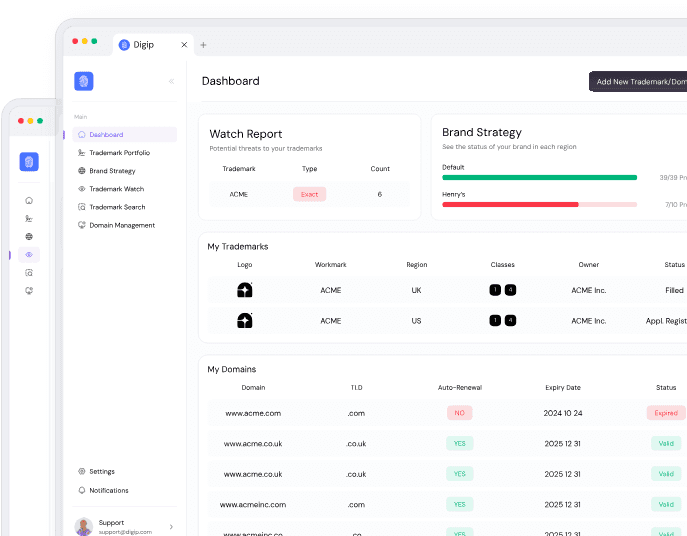
7. Can you see your live trademark count right now, without asking anyone? If you have to email someone to find out how many live marks you have, you don't have a system. You have a filing cabinet with a phone number attached.
Good answer sounds like: a login, not a person.
Red flag: "let me check and get back to you," for a number that should be live.
8. Are your domains and your marks tracked together? A domain is where your mark lives online. A mark with no matching domain, and a domain with no matching mark, are both gaps, and both are common.
Good answer sounds like: one system flags both kinds of gaps automatically.
Red flag: "that's a separate team," or "check with your registrar."
Ownership
9. If you leave, do you keep your history? Every renewal date, every filing, every piece of correspondence belongs to you, not the provider.
Good answer sounds like: a clear export process, specified now, before you need it.
Red flag: silence, or an answer that requires a lawyer to interpret.
10. Does the provider own its own software, or license someone else's? A firm running on generic, licensed docketing software is limited to what that software lets it automate, and pays a third party for the privilege. A firm that owns its own software controls both the automation and the cost structure underneath the price you pay.
Good answer sounds like: specifics on what's actually automated end to end, renewal tracking, jurisdiction gaps, domain-to-mark matching, not just "we use modern tools."
Red flag: "we use standard docketing software," with nothing built for how your portfolio specifically needs to be managed.
Where this fits
These ten questions apply to any provider. Whether the answer should be us depends on what your portfolio actually looks like right now.
Good fit if:
The portfolio is actively growing: new marks, new classes, new jurisdictions, on a real cadence.
The brand is doing commercial work: tied to fundraising, expansion, new products, or M&A, not sitting quietly on a shelf.
Coordination is already a felt cost: multiple local firms, multiple invoices, no one person who can state the live mark count from memory.
Domains and marks need to be checked against each other, and currently aren't.
"As we expand in Europe, it is important to have a partner who stands by us and with whom we can discuss as much we want."
Anna Wallander, CEO
Not a fit if:
The brand isn't a key strategic asset. This shows up two ways: a company pulling back from the markets it once filed in, or a company consolidating many brand names down to fewer. Either way, the mark count is flat or shrinking, and the names you hold aren't doing active commercial work. Coordinating a portfolio only matters if there's a portfolio being actively built. A handful of quiet registrations need a lawyer for renewals, not a system.
The business itself is in decline. Shrinking revenue and market position usually means trademark activity shrinks with them: renewals on a portfolio that's mostly getting smaller, no new filings, no new jurisdictions, no new classes. That's a maintenance task, not a coordination problem. A single local firm handling renewals will almost always cost less than a platform built for growth.
Where we land
We're built around one problem: a growing portfolio shouldn't get harder to see or more expensive to coordinate as it scales. Centralized and flat rate, sized to the portfolio, across more than 190 jurisdictions, is how we solve it. The typical result: 30-50% less than traditional counsel. Clearance, registration, watching, portfolio and matter management, domain management, and enforcement all run inside Legal Hub.
Every jurisdiction we file in runs through an admitted attorney, ours or one of the 15+ local counsel firms in our network. Which firm is on record for which jurisdiction lives inside the same portfolio record as everything else. Not a separate lookup.
We own the software the portfolio runs on. We didn't license a generic docketing tool and add legal services on top. That's what makes the automation possible: renewal tracking, jurisdiction gap-flagging, domain-to-mark matching, built into the system rather than checked by hand. It's also what makes the flat rate possible. There's no third party's software margin sitting inside our price.
"Digip helped us to cut our workload by 80%, while providing a smooth and functional clarity."
Ann Adelsson, CEO at Gudrun Sjödén
The system holds the estate together in real time. You see it. You don't ask for it.
We're a law firm, not a filing platform borrowing legal language. The system tracks the estate. The attorneys make the legal calls. Every step is on the record.
If a provider can't answer these ten questions this directly, that's the answer too.